

Gelug · The Founders
Gelug is the youngest of the four major schools of Tibetan Buddhism, and also the one with the clearest lineage of patriarchs. It has a definite founder — the great master Je Tsongkhapa (1357–1419); a definite source — the Atīśa who came to Tibet in the eleventh century; and definite successors — Gyaltsab Je, Khedrup Je, and thereafter the two great lineages of the Dalai Lama and the Panchen Erdeni.
This chain is unlike Nyingma's, which spans a thousand years blending myth and history, and unlike Kagyu's, whose core metaphor is the "golden chain of ear-to-ear transmission." Gelug's transmission is more like a stairway of study: each patriarch added one step, and later generations ascend it.
Each figure on this transmission has a dedicated article of its own.
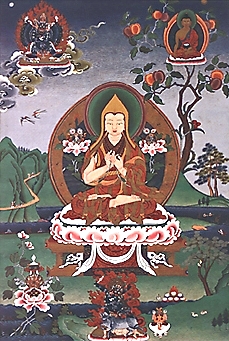

1. The Three Venerable Ones: Teacher and Two Disciples
- Tsongkhapa (Tsongkhapa, 1357–1419) — founder of Gelug; author of the *Lamrim Chenmo* and the *Ngakrim*; builder of Ganden Monastery; reviver of discipline and the graduated path.
- Gyaltsab Je (Gyaltsab Je, 1364–1432) — among Tsongkhapa's foremost disciples; succeeded as the second Ganden Tripa; known for commenting on Tsongkhapa's treatises.
- Khedrup Je (Khedrup Je, 1385–1438) — another chief disciple of Tsongkhapa; third Ganden Tripa; later recognized as the First Panchen Lama.
The three are collectively called the "Three Venerable Ones, Teacher and Disciples" (རྗེ་ཡབ་སྲས་གསུམ་), the most common grouping in Gelug thangkas: Tsongkhapa at the center, the two disciples to his sides.
The meaning of this grouping lies in relay: the founder lays down the rules, the successors keep them and pass them on. That Gelug has endured six hundred years rests not on Tsongkhapa's wisdom alone, but on this chain of relay.
2. Biographies of the Patriarchs
Each opens into a full illustrated article:
3. Atīśa: A Voice from Two Centuries Before
Although Gelug is a fifteenth-century product, its spiritual source reaches back to the Atīśa (982–1054).
Atīśa was a great scholar of India's Vikramaśīla, invited to Tibet in 1042 by the Guge kingdom. At that time, though Buddhism had been revived for a century, abuses abounded: emphasizing tantra over sūtra, disordered sequence, lax discipline, even indulgence in the name of "union" or "liberation."
Atīśa's response was to write the *Bodhipathapradīpa* (Lamp for the Path), dividing all Dharma into three levels — lesser, middling, greater — according to aptitude, and affirming sūtra before tantra, discipline as the foundation, gradual progress. His disciple Dromtönpa founded the Kadam school, devoted to this graduated path.
Three centuries later, Tsongkhapa read Atīśa's works and was suddenly illuminated. The Gelug he later established is in spirit a direct continuation of Atīśa — hence Gelug is also called "New Kadam."
This affinity shows one thing: a true reform is often not conjured from nothing, but a forgotten old answer restated. Atīśa's answer was finally brought to fruition when Tsongkhapa re-answered it three centuries later.
4. Gyaltsab Je and Khedrup Je: Those Who Kept the Rules
When Tsongkhapa passed away in 1419, what he left was a just-formed community. Whether it would continue depended on his successors.
Gyaltsab Je (1364–1432) was originally a Sakya scholar, famed for his eloquence, and had joined Tsongkhapa's fold after being bested in debate. As Ganden Tripa, his main work was commenting on Tsongkhapa's treatises, fixing the teacher's thought into teachable texts. Without him, much of Tsongkhapa's teaching might have remained oral.
Khedrup Je (1385–1438) excelled in tantra and debate, and was likewise prolific. He was later recognized as the First Panchen Erdeni, the source of one of Gelug's two reincarnate lineages.
Their division of labor is intriguing: one was responsible for writing down the teaching (fixing doctrine), the other for practicing it out (realization and transmission). The later Gelug temperament — valuing both learning and practice — was founded by these two.
This is also where Gelug differs from other schools in its view of patriarchs: it does not especially worship miracles and auspicious signs, but rather asks whether "this person passed the Dharma on."

5. The Dalai Lama: Emanation of Avalokiteśvara
Of Gelug's two great reincarnate lineages, the Dalai Lama (ཏཱ་ལའི་བླ་མ་) is the best known to the world.
This lineage begins with Gendün Drup (1391–1474), a disciple of Tsongkhapa, recognized posthumously as the First Dalai Lama. The Third Dalai Lama, Sönam Gyatso, met the Mongol Altan Khan in 1578 and was granted the title "Dalai Lama" ("Dalai" is Mongolian for "ocean," likening his knowledge to the sea); it then became a fixed title.
The Fifth Dalai Lama (1617–1682) is the key figure of this lineage: he unified Tibet and established the Ganden Phodrang regime, after which Gelug became the dominant religious and political force in Tibet. Subsequent Dalai Lamas have been both religious and political leaders.
Gelug holds the Dalai Lama to be the emanation of Avalokiteśvara; each successive incarnation is found, recognized, and enthroned through formal procedures. The present Fourteenth Dalai Lama has lived in exile in Dharamsala, India, since 1959.
To understand the Dalai lineage is to understand its role within Gelug: it is both the core of faith and the pivot of the institution — a concrete thread that holds the community together.
6. The Panchen Erdeni: Emanation of Amitābha
The other great lineage is the Panchen Erdeni (པན་ཆེན་ཨེར་ཏེ་ནི་), seated at Tashilhunpo Monastery in Shigatse.
"Panchen" means "Great Paṇḍita" (great scholar). This lineage traces Khedrup Je as its First, and was established as a reincarnation system by the Fourth Panchen, Lobsang Chökyi Gyaltsen (1570–1662); the Fifth Panchen received the title "Panchen Erdeni" from the Qing Kangxi Emperor in 1713 ("Erdeni" is Manchu for "treasure").
Gelug holds the Panchen to be the emanation of Amitābha (the Buddha of Boundless Light). The Dalai and Panchen lineages have historically been linked by teacher-disciple relations: usually the living one presides over the search and recognition of the other, each serving as the other's teacher.
The two lineages standing side by side form Gelug's stable leadership: one in central Tibet (Lhasa), one in western Tibet (Shigatse); one presiding over Avalokiteśvara's compassion, the other over Amitābha's light. This twin-center design gave Gelug a rare resilience in politics.
7. Studying and Relying on a Teacher: Gelug's Entry Sequence
Gelug's advice to beginners is extremely clear, summarized in four steps:
One, draw near a spiritual friend — first find a qualified guru; this is the first step Gelug repeatedly stresses. In the *Lamrim*, Tsongkhapa spends great length on "relying on a spiritual friend," which he regards as the root of all virtues.
Two, hear the true Dharma — receive the teaching of the graduated path from the guru; first clarify the map of practice; do not rush onto the road.
Three, reflect rightly — turn what you have heard over and over in analysis until it becomes your own conviction, not mere memorized phrases. This is precisely the meaning of debate.
Four, practice in accord with Dharma — begin practice from the foundation of the lesser scope (death and impermanence, deep trust in cause and effect), ascending step by step.
The core spirit of this sequence is: first understand how the path goes, then walk it. Gelug rarely encourages "start practicing first and see" — it holds that a wrong direction only carries you farther the faster you go.
Frequently Asked Questions (FAQ)
Q: Who founded Gelug?
A: Je Tsongkhapa (1357–1419). In 1409 he founded Ganden Monastery and authored The Great Treatise on the Stages of the Path to Enlightenment, advocating reforms of discipline and progressive stages; thus Gelug took shape.
Q: Why is Gelug called the 'New Kadampa'?
A: Because Tsongkhapa's teaching directly inherits the Stages of the Path tradition of Atisha's Lamp for the Path to Enlightenment and the Kadampa school of the eleventh century; he merely recompiled, expanded, and institutionalized it.
Q: Which is greater, the Dalai Lama or the Panchen Lama?
A: In religious standing the two are equal; they belong respectively to the systems of central and western Tibet (Ü and Tsang), and historically have been in a mutual teacher–disciple relationship. There is no simple matter of who is greater.
Q: What is the Ganden Tripa?
A: The throne-holder of Ganden Monastery—the supreme doctrinal authority of the Gelug school. Held by one of eminent learning and conduct, it is not a reincarnation line but a seven-year term, and is the most revered scholarly office in Gelug.
Image & video credits
- Tsongkhapa.jpg · Unknown authorUnknown author / Public domain
- Annales du musée Guimet, Bod-Youl ou Tibet (1906) p188.jpg · AnonymousUnknown author / Public domain
- Annales du musée Guimet, Bod-Youl ou Tibet (1906) p186.jpg · AnonymousUnknown author / Public domain
