

Je Tsongkhapa
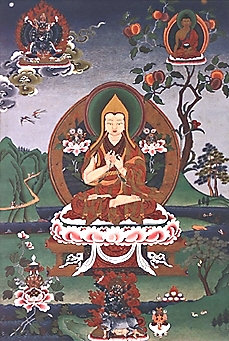
Je Tsongkhapa (Tsongkhapa, 1357–1419) is the founder of the Gelug school of Tibetan Buddhism, revered as the "Second Buddha." He is remembered not for miracles nor for the legend of austerities, but for three things: one treatise, one monastery, one set of rules.
In the history of Tibetan Buddhism, Tsongkhapa is a turning point. Before him, Tibetan Buddhism had long been in a state of lax discipline and disordered sequence; after him, a vast community built on discipline and curriculum gradually took shape, eventually becoming the most widely influential branch of Tibetan Buddhism.
His life is almost the very act of "rebuilding the rules."
1. From Amdo to Ü-Tsang: One Man's Path of Study
Tsongkhapa was born in 1357 in Huangzhong, Qinghai (present-day Kumbum), originally named Lobsang Drakpa. He became a monk at seven and left home at sixteen for Tibet to seek the Dharma, never to return.
In the more than thirty years he spent in Ü-Tsang, he read nearly every scripture then available. He studied successively under gurus of the Sakya, Kagyu, Kadam, and Nyingma schools, learning exoteric sūtras, logic, Madhyamaka, tantra, and various instructions. This attitude of belonging to no single school and studying widely was rare for its time and determined the breadth of his later vision.
Legend has it that he long conversed with Mañjuśrī in pure visions, resolving many doubts on the Madhyamaka view. Gelug's telling is restrained about this — the emphasis always on the settling of the view, not on the vision itself.
This period of study gave him a rare ability: he could see both the strengths and the flaws of each school. A reformer is often not an outsider, but one who has read the system through.
2. What He Saw as the Problem
Fourteenth-century Tibetan Buddhism, prosperous on the surface, had three internal sores:
Lax discipline — monks marrying, drinking, trading; blurred lines between monastic and lay life.
Disordered sequence — many practiced tantra without studying sūtra, performed deity yoga without empowerment, even abandoning cause and effect in the name of "transcending discrimination."
Faulty view — grave divergence on the meaning of emptiness: one side lapsed into nihilism, taking "emptiness" as "nothing at all"; another reified it, treating "emptiness" as some kind of substance.
Tsongkhapa's diagnosis was this: the problem is not a lack of profound Dharma, but that the foundation has collapsed. Without renunciation and bodhicitta, tantra is but an empty shell; without discipline, the monastic community is merely laypeople; without correct view, all practice may go in the wrong direction.
So he did two things: write books, and set rules.
3. The *Lamrim Chenmo*: A Complete Map of the Path
In 1402, Tsongkhapa wrote the Great Treatise on the Stages of the Path (ལམ་རིམ་ཆེན་མོ་, Lamrim Chenmo), his most important and influential work.
Its structure unfolds according to the three scopes:
- The lesser scope — contemplating death and impermanence, fearing the suffering of the lower realms, taking refuge in the Three Jewels, deeply trusting cause and effect; the goal is a favorable rebirth among humans and gods.
- The middling scope — observing the faults of saṃsāra, arousing the renunciant mind, cultivating ethics, concentration, and wisdom; the goal is liberation from the cycle of rebirth.
- The great scope — arousing bodhicitta, cultivating the six perfections and four means of conversion; the goal is Buddhahood for the benefit of others.
The three scopes are not three choices but layered foundations: without the lesser scope's right view of cause and effect, the middling scope's renunciation cannot arise; without the middling scope's renunciation, the great scope's bodhicitta is a castle in the air.
Another great contribution of this treatise is that it places every scripture and practice within this framework — whatever sūtra or method you read, you can find its place on the graduated path. This makes it not only a manual of practice but an encyclopedic map of Tibetan Buddhism.
In 1409 he built Ganden Monastery, and the Gelug school formally took shape.

4. Settling the View: The Prāsaṅgika Madhyamaka
Besides the graduated path, Tsongkhapa's other key contribution is the settling of the view.
He adjudged the view of the Prāsaṅgika Madhyamaka (Prāsaṅgika, following Candrakīrti's *Madhyamakāvatāra*) as the ultimate: all phenomena lack inherent nature (empty), yet the function of dependent arising is not impaired (present). These two are two sides of the same thing — precisely because there is no inherent nature, dependent arising is possible; precisely because of dependent arising, selflessness is established.
He was especially wary of one abuse: understanding "emptiness" as "nothing at all," thereby denying cause and effect and practice. He repeatedly stressed that emptiness does not negate phenomena, but negates the independent, unchanging essence behind them. The often-repeated saying — "to use emptiness to demolish cause and effect is a demonic teaching" — says exactly this.
In Gelug's curriculum, the *Madhyamakāvatāra* therefore became the most valued of the Five Great Treatises; and the placing of logic (epistemology) first serves precisely to grind the view until it withstands questioning.
This attitude is the root of the Gelug temperament: the view may be supremely high, but it must withstand logical scrutiny.
5. What He Left Behind
In 1419, Tsongkhapa passed away at Ganden Monastery. The three things he left shaped Tibetan Buddhism for six hundred years thereafter:
One treatise — the *Lamrim Chenmo* and the *Ngakrim* (Great Treatise on the Stages of the Vajrayāna Path), which laid out the path of practice and remain to this day Gelug's fundamental textbooks, widely referenced by other schools as well.
One monastery — Ganden, the cradle of Gelug; the successive Ganden Tripas are Gelug's highest doctrinal authority.
One institution — the curriculum of the Five Great Treatises, the testing through debate, the Geshe degree, and the monastic norms of strict discipline. This institution allowed Gelug to reproduce a standard monastic community anywhere, and is the root reason it became the largest school.
He also had two outstanding disciples: Gyaltsab Je and Khedrup Je, who successively served as Ganden Tripa, fixing his teaching into teachable texts and passing them on. The three are collectively called the "Three Venerable Ones, Teacher and Disciples."
Tsongkhapa never returned to Qinghai. But his Dharma returned to that land — his birthplace later became Kumbum Monastery, the Gelug center in Amdo.
Frequently Asked Questions (FAQ)
Q: Which school did Tsongkhapa found?
A: He was the founder of the Gelug school. In his youth he studied widely across the Sakya, Kagyu, and Kadampa traditions, and finally built Gelug on the framework of Atisha's Stages of the Path; for this reason Gelug is also called the "New Kadampa".
Q: Which is his most important work?
A: The Great Treatise on the Stages of the Path to Enlightenment (Lam rim chen mo). Others—such as The Great Treatise on the Stages of the Path in Vajrayana, his commentary on Chandrakirti's Entering the Middle Way, and his Elucidation of the Intention (on the definitive and provisional meanings)—are all foundational Gelug texts.
Q: Why do Gelug monks wear yellow hats?
A: When Tsongkhapa undertook his reforms he wore the yellow pandita hat to signal the revival of monastic discipline. The yellow hat then became the emblem of Gelug, and the Chinese consequently dubbed it the "Yellow Hat" school.
Q: What is his connection to the Dalai and Panchen Lamas?
A: His disciple Gendun Drub was later recognized as the First Dalai Lama, and another disciple, Khedrup Gelek Pelzang, as the First Panchen Erdeni. Both of Gelug's two great reincarnation lineages thus trace back to his disciples.
Image & video credits
- Tsongkhapa.jpg · Unknown authorUnknown author / Public domain
- Annales du musée Guimet, Bod-Youl ou Tibet (1906) p188.jpg · AnonymousUnknown author / Public domain
Return to the parent page: The Founders of Gelug.
